Research & Development
Every formulation in the catalog starts from a soil and crop profile, not a shelf of pre-mixed bags.

Two crops on the same NPK ratio, grown in different soils, can respond completely differently — the limiting factor is rarely the nutrient itself, it's whether the soil can hold and release it in a form the root can actually take up. That's why formulation work starts with soil texture, not a target yield number.
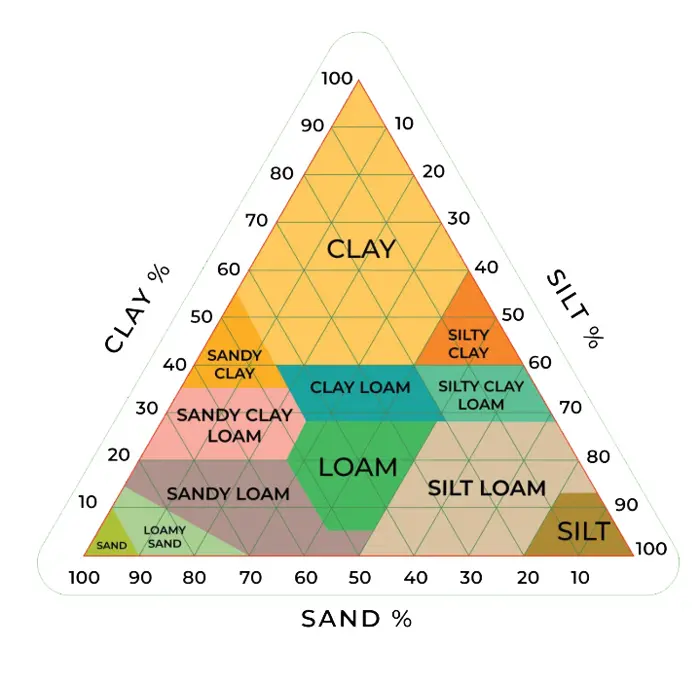
Sand, silt, and clay proportions determine cation exchange capacity, drainage rate, and how tightly a soil holds onto — or loses — a given nutrient form. A sandy loam leaches nitrate quickly and needs either split applications or a slow-release nitrogen source; a clay-heavy soil holds nutrients tightly but can lock up phosphorus and micronutrients at high pH, which is exactly the problem chelation (EDTA, EDDHA, DTPA) exists to solve. Plotting a soil's sand/silt/clay percentages on the standard USDA texture triangle is the first step in specifying which formulation family — standard salt, chelated, or slow-release — actually fits a given field, before concentration or ratio is even discussed.
The same crop needs a different NPK balance at establishment, vegetative growth, flowering, and fruit fill — nitrogen-heavy ratios early, potassium-heavy ratios approaching harvest. This is why the catalog is organized around specified ratios (10-52-10, 13-7-40 + TE, and so on) rather than a single "all-purpose" product: a formulation that's correct for vegetative growth is usually the wrong choice for fruit fill, regardless of the crop.
West Asia and North/West Africa's predominantly calcareous, alkaline soils are the specific reason the catalog leans on EDDHA-Fe rather than EDTA-Fe for iron correction in this region — EDTA chelates lose stability above roughly pH 6.5–7, exactly the range most of these soils sit in, while EDDHA holds iron in solution up to pH 9–10. Irrigation water salinity is the other regional variable that changes which formulation makes sense: high-salinity irrigation water favors potassium sulfate over potassium chloride sources, and water-soluble fully-chelated micronutrient blends over standard salts, to avoid compounding salt stress on the root zone.
Specifying by soil and stage rather than selling a single generic blend has a direct, measurable effect: less nutrient applied than the crop can use gets wasted as runoff or leached past the root zone, chelated micronutrients stay plant-available instead of precipitating out in alkaline soil, and growth-stage-matched ratios reduce the lodging and quality problems that come from over-applying nitrogen late in a crop cycle. It's also why the Product Finder asks for growth-stage goal and soil condition before narrowing the catalog, rather than presenting all 134 products and leaving the match-up to guesswork.